


Ganesh Chaturthi, also known as Vinayak Chaturthi, celebrates the birth of Lord Ganesha—the beloved deity of wisdom, prosperity and good fortune. Observed during the Hindu lunar month of Bhadrapada, usually between August and September, the festival will begin this year on September 14 and culminate on September 25 with Ganesh Visarjan.
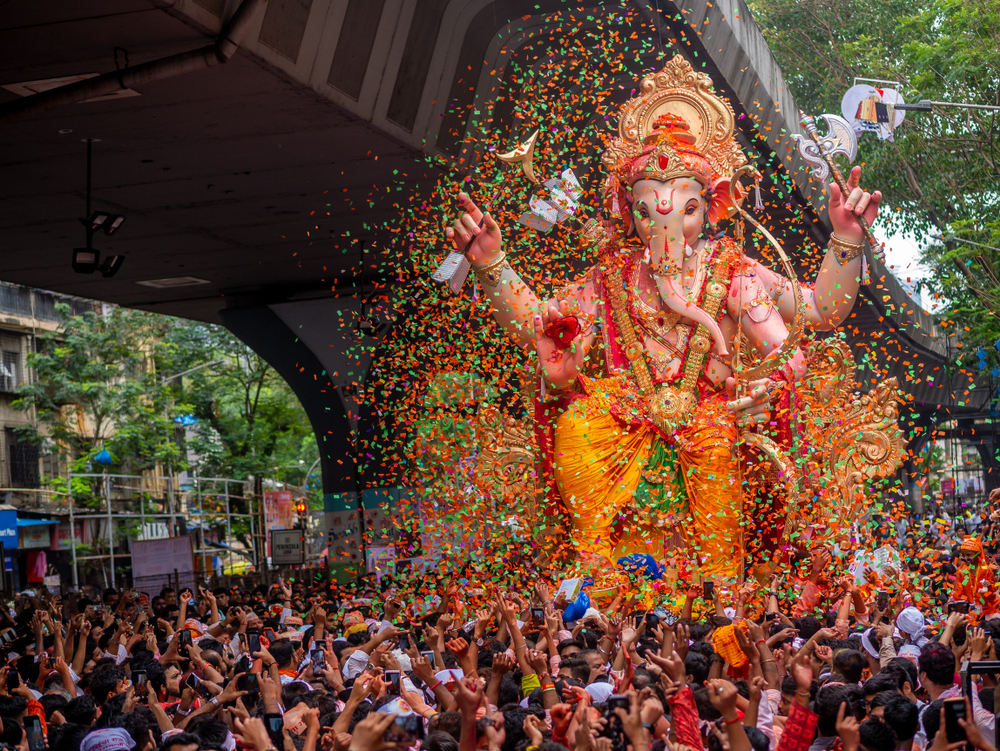
Across India, the celebrations unfold with magnificent scale and infectious energy. Towering clay idols of Ganesha take centre stage in elaborately decorated public pandals, while homes come alive with prayers, aartis and tables laden with festive delicacies. The grand finale is Ganesh Visarjan, when thousands accompany the idols in exuberant processions filled with music and dancing before their ceremonial immersion in water—a spectacular and deeply emotional farewell to the much-loved god.

Although Ganesh Chaturthi is celebrated across India, nowhere does the festival unfold with quite the same fervour as in Maharashtra.
Where to Celebrate: Travellers from around the world arrive in Maharashtra to experience its spectacular processions, elaborate pandals and infectious festive spirit. Here are some of the best places to join the celebrations.
1. Mumbai
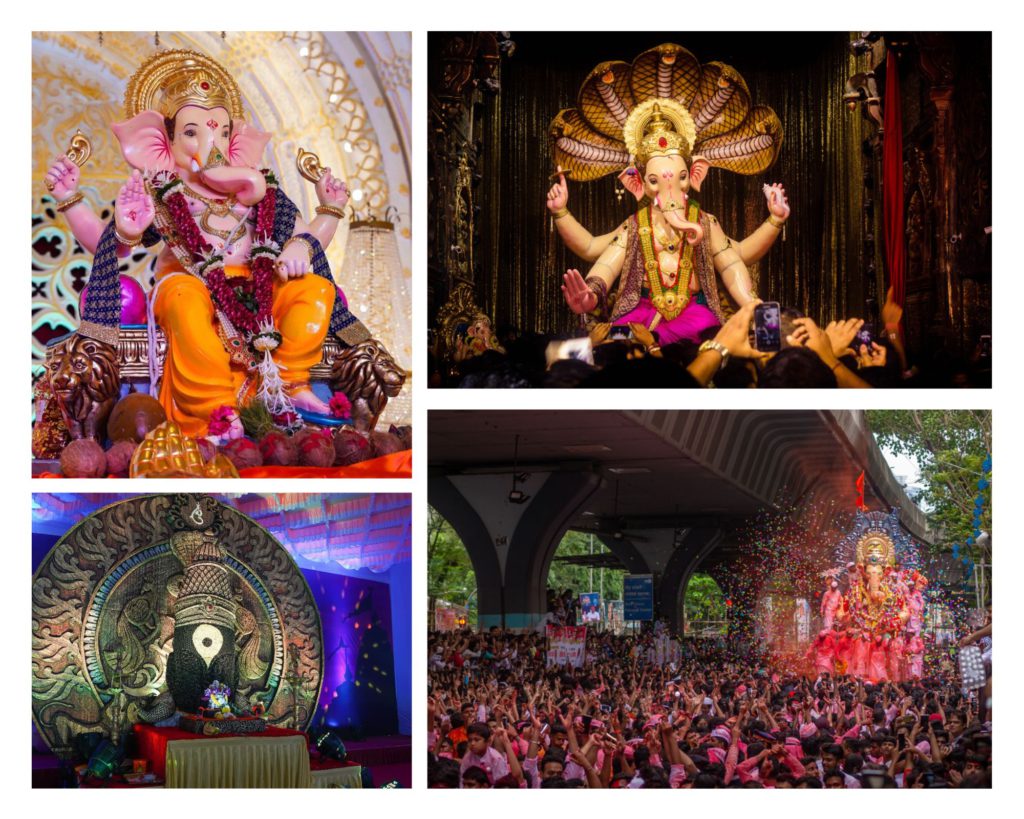
Mumbai celebrates Ganesh Chaturthi with an exuberance entirely its own. For ten exhilarating days, chants of “Ganpati Bappa Morya” echo through the city’s lanes as neighbourhood mandals compete to create the most spectacular welcome for Lord Ganesha. Months of work by artists, sculptors, volunteers and craftspeople culminate in monumental idols, elaborate pandals and processions that bring the city to a joyous standstill.
Begin at the Goud Saraswat Brahmin (GSB) Samiti Mandal in Wadala, known for presenting one of Mumbai’s most richly adorned Ganesha idols. No festival itinerary, however, is complete without Lalbaugcha Raja. Established in 1934 as a community celebration rather than a traditional shrine, Mumbai’s most famous Ganpati reportedly attracts more than 1.5 million devotees each day. This year, the 12-foot idol appears in a regal pose upon a throne, against a pandal inspired by the Ram Temple in Ayodhya.
A few lanes away stands Mumbaicha Raja at Ganesh Galli, another crowd-puller celebrated for its ambitious annual themes. This year’s pandal recreates Varanasi’s Kashi Vishwanath Temple. In the western suburbs, Andhericha Raja, founded in 1966 by workers from Tata Special Steel and Excel Industries, is especially popular with Mumbai’s film fraternity.
Then there is Chinchpoklicha Chintamani, presented by the Chinchpokli Sarvajanik Utsav Mandal, which dates back to 1920. Its arrival and visarjan processions are among the festival’s most stirring spectacles, with thousands of devotees dancing through the streets.
At the GSB Seva Mandal in King’s Circle, visitors can see one of the country’s most opulently decorated Ganpati idols, adorned with extraordinary quantities of gold and silver. Complete the trail at the revered Shree Siddhivinayak Ganapati Temple, where vast crowds gather during the festival to seek Ganpati Bappa’s blessings.
2. Pune
Pune is widely regarded as Maharashtra’s cultural capital, and during Ganesh Chaturthi, the city becomes one of the most rewarding places to experience the festival. If you are visiting this year, make time for its celebrated pandals and join the festivities.
The city’s five most revered Ganpati idols begin with Shri Kasba Ganpati Sarvajanik Ganeshotsav Mandal in Budhwar Peth. Established in 1893, it remains among Pune’s most venerated deities. Nearby, the 15-foot-tall Tulshibaug Ganpati is the city’s largest and takes on an imaginative new theme each year.
Equally iconic is Tambdi Jogeshwari Ganpati, also in Budhwar Peth. Its celebrations were initiated by Lokmanya Tilak in 1893, while the idol’s original form has been preserved and crafted by the same family for more than four generations.
On Lakshmi Road, Guruji Talim Ganpati dates back to 1887, making it one of Pune’s oldest mandals. Completing the illustrious five is the Kesariwada Ganeshotsav Trust, established in 1894 and still one of the city’s most cherished celebrations.
3. Ganapatipule
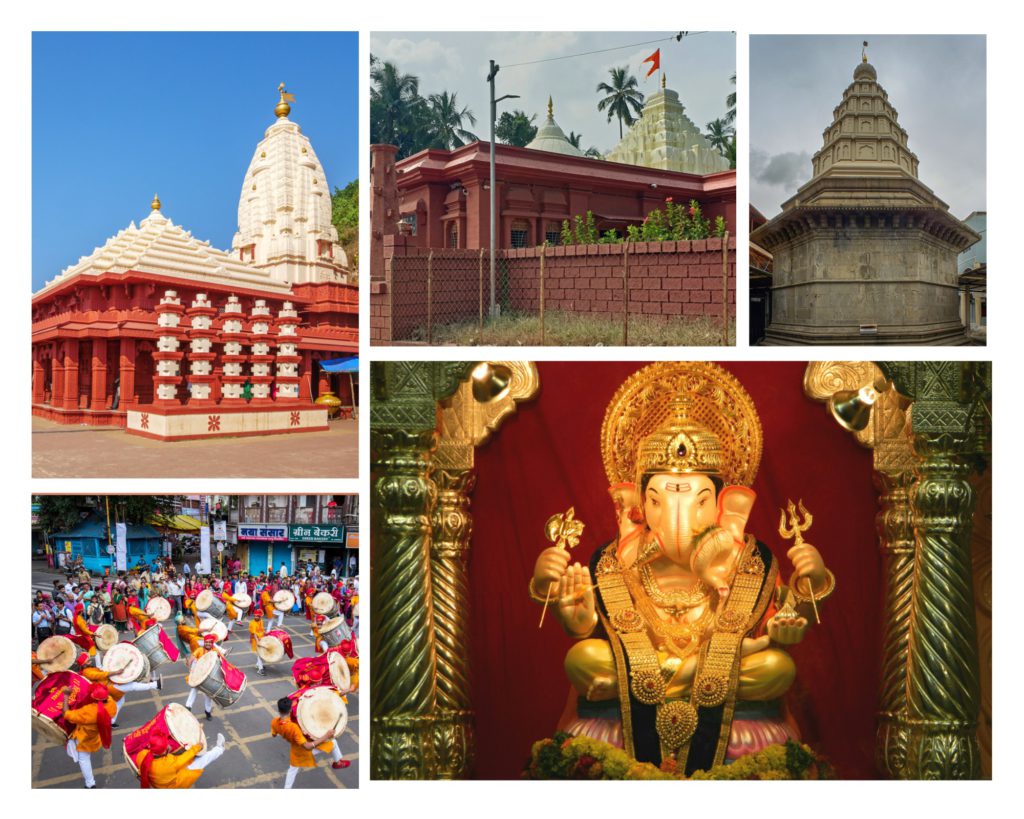
Set along Maharashtra’s Konkan coast, Ganpatipule is a small seaside town framed by beautiful beaches and sweeping views of the Arabian Sea. Its principal attraction is the 400-year-old Swayambhu Ganpati Temple, an ancient shrine occupying an extraordinary position directly beside the beach. Inside are two representations of Lord Ganesha: one formed naturally from fine white sand and another cast in brass, depicting the deity astride a lion. At certain times, the sun’s golden rays enter the sanctum, bathing the shrine in a warm, almost ethereal light.
During Ganesh Chaturthi, villagers and pilgrims come together in a spirited procession at the temple. Prayers, rituals and communal feasts fill the ten-day celebration, lending Ganpatipule’s serene coastline a rare festive energy.
4. Diveagar
Diveagar, a quiet coastal village in Maharashtra’s Raigad district, comes alive for Janmashtami and Ganesh Chaturthi, its two most important festivals. At its spiritual heart is the 300-year-old Suvarna Ganesh Temple, renowned for its golden representation of Lord Ganesha. Rich in history and local legend, the temple is an essential stop for culturally curious travellers.
5. Pali
Pali may be a tiny town in Maharashtra’s Raigad district, but it holds immense religious significance. Its Ballaleshwar Temple is one of the eight sacred shrines that form the state’s revered Ashtavinayak pilgrimage circuit and draws devotees of Lord Ganesha throughout the year. The temple contains two sanctums. The 15-foot-high inner chamber houses a three-foot idol of Ganesha seated on a stone-carved throne with an ornate silver backrest. In the 12-foot-high outer sanctum, a stone mouse—the deity’s faithful vehicle—faces Ganesha while holding a modak. During Ganesh Chaturthi, Pali takes on a livelier rhythm as prayers, rituals and religious gatherings unfold around the temple, drawing pilgrims from across Maharashtra.
What To Eat:
In Maharashtra, no Ganesh Chaturthi celebration is complete without the traditional delicacies prepared for the occasion. If you are visiting during Ganpati season, arrive hungry: these are the six festive dishes you must try.
- Modak: Lord Ganesha’s fondness for modak is legendary—so much so that he is known as Modakpriya. Traditional ukadiche modak are delicate, steamed dumplings made with rice flour, coconut and jaggery, and offered to the deity as prasad. Contemporary versions range from chocolate and kesar to fried, coconut-crunch and dried-fruit modaks. In Mumbai, try them at Modakam in Prabhadevi, Aaswad in Dadar, Jhama Sweets in Chembur or JW Marriott Sahar in Andheri. Pune favourites include Kaka Halwai, with flavours such as mawa, chocolate and mango; Chitale Bandhu Mithaiwale; Hotel Shreyas in Deccan Gymkhana; Joshi Sweets in Erandwane; and Gaurav Snacks in Sadashiv Peth.
- Puran Poli: Beyond modak, puran poli is one of Ganesh Chaturthi’s most cherished sweets. This soft flatbread is filled with chana dal, jaggery and cardamom, then finished with a generous helping of ghee. It is offered to Lord Ganesha as bhog and shared with devotees as prasad. In Pune, try it at Hotel Shreyas, Mumma’s Kitchen, Peshwa or Poona Guest House. In Mumbai, Bhaskar’s Puranpoli Ghar in Thane West serves an impressive variety.
- Shrikhand: A Maharashtrian favourite, shrikhand is often served as prasad during Ganesh Chaturthi. The silky dessert combines strained yoghurt and sugar with cardamom, chironji and saffron, while contemporary versions introduce fresh fruit flavours. For an authentic taste, visit Shree Thaker Bhojanalay in Mumbai or Chitale Bandhu Mithaiwale in Pune.
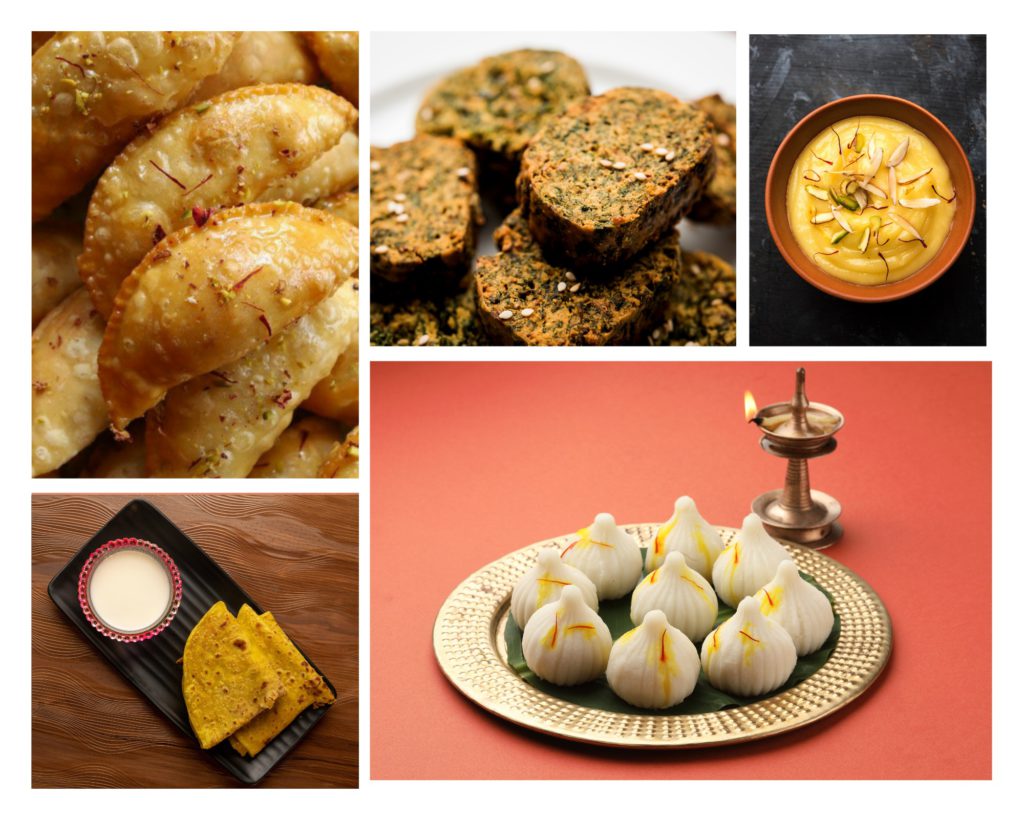
- Kaju Kothimbir Vadi: In Marathi, kothimbir means coriander and vadi refers to a savoury fritter. Made from chickpea flour, fresh coriander and spices, the batter is first steamed, then sliced and fried until crisp. A festive favourite, it is best enjoyed alongside other Maharashtrian savouries. Try the kaju kothimbir vadi at Diva Maharashtracha in Mumbai, or visit the popular Annapurna Vadi Centre on Bajirao Road in Pune..
- Varan Bhat: Varan is a comforting lentil curry, while bhaat means steamed rice. A Ganesh Chaturthi staple, it combines moong and arhar dals with curry leaves, grated coconut and cumin seeds. The dish is offered to Lord Ganesha alongside vegetables such as batata bhaji and beans bhaji. Try it with other authentic Maharashtrian fare at Aaswad Upahar & Mithai Grih in Mumbai’s Shivaji Park or Ishaan Foods in Pune.
- Karanji: Another Maharashtrian delicacy offered to Lord Ganesha, karanji resembles the North Indian gujiya. These crisp, fried pastries contain a fragrant filling of coconut, sesame seeds, almonds, cashews, raisins, cardamom, nutmeg, sugar and ghee. For a taste, visit Panshikar Sweets in the lane beside Citylight Market in Mahim, Mumbai, or one of Kaka Halwai’s stores across Pune.
Related Coverage:
Food Guide | Maharashtra On My Plate
Maharashtra: The Evergreen Vacation Destination | Travel Guide
Food Guide: Maharashtra’s Unusual Melange of Culinary Delights